This article covers technology for small-business owners and staff. It is free to read.
Imagine you run a small workshop and want to add vehicle chargers and a new machine. You ask about power, and the answer depends on grid sensor data you have never seen. That is the quiet story behind a new kind of drone for electricity networks.
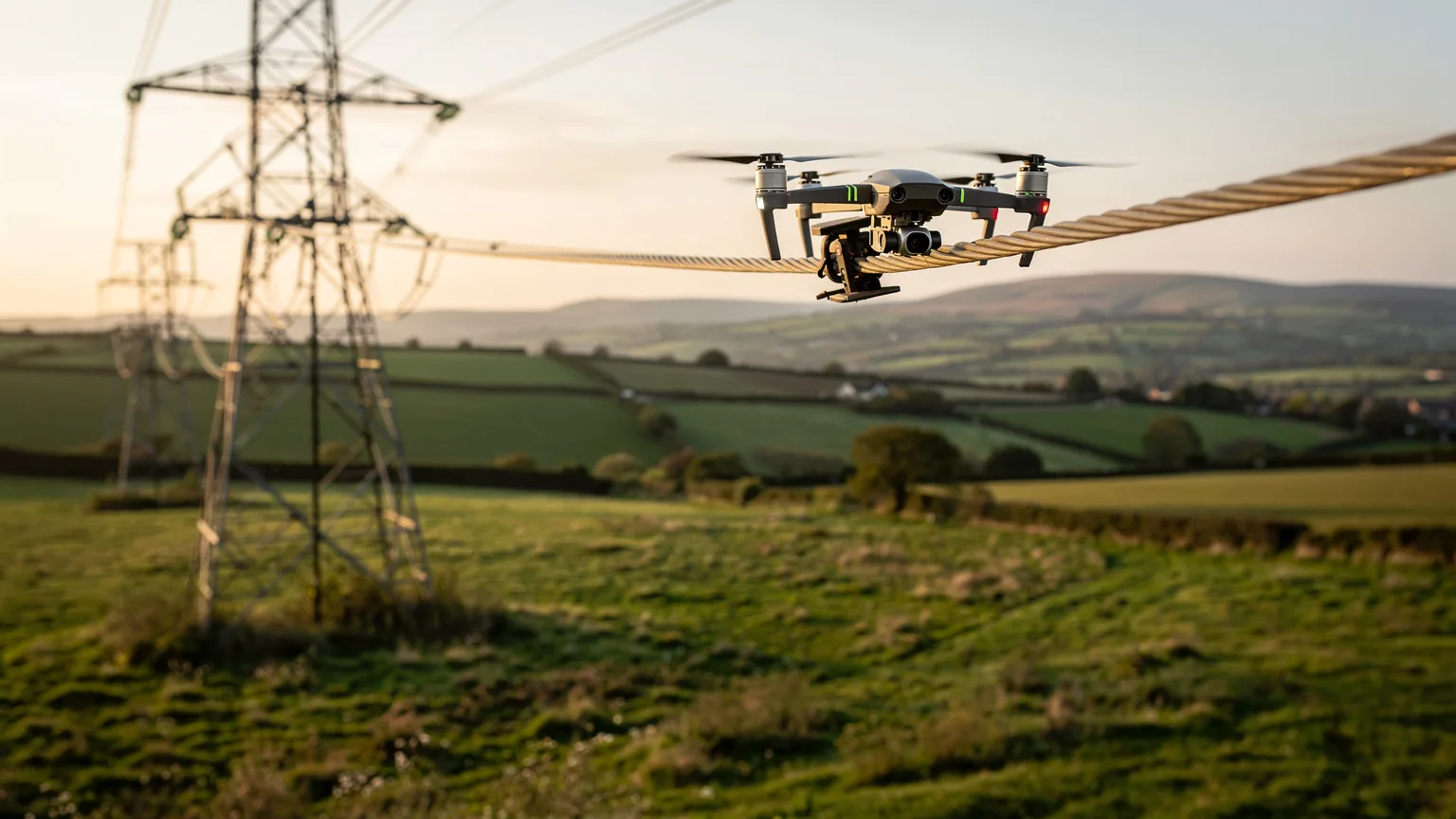
The aircraft are built by a Munich-based startup called Nomadic. Each weighs four kilograms, lands on a live power line and recharges from it without interrupting supply. The practical lesson reaches well beyond the grid.
What the drones actually do
The drones draw energy from the magnetic field around a line through electromagnetic induction. They top up their batteries while perched on the conductor, then use that energy to fly to another spot.
That means crews do not have to keep retrieving the aircraft for fresh batteries. The company says its drones have logged more than 20,000 hours on live lines, including in temperatures as low as minus 25°C and on lines carrying up to 420 kilovolts.
Why line conditions matter
The amount of electricity a line can safely carry changes with its surroundings. Current heats the conductor, while wind and cooler air carry heat away. Conditions can differ along a route, so one reading may miss the most restricted stretch.
This supports an approach called dynamic line rating, where limits follow real conditions. The International Energy Agency explains that it can reveal capacity left unused by cautious assumptions. Other equipment, such as transformers and substations, may still restrict the overall route.
Mobile sensors versus fixed ones
Nomadic says one drone can cover roughly 25 kilometres of line, while fixed sensors are typically installed every one to five kilometres. A movable sensor could help investigate a particular stretch without fitting more equipment everywhere.
There is a catch. A drone does not measure every point at once, and fixed sensors stay put. Which is better depends on what you need to measure and how often.
The limits worth remembering
This is not endless flight or maintenance-free operation. The 20,000 hours refer to time on live lines, and the drones still land to recharge. Battery condition, weather, communications and servicing all remain practical concerns.
The company has also raised US$6 million and plans remote relocation in 2027, so staff could direct a drone from the office. Its announcement gives deployment figures but does not establish independently verified savings in costs, emissions or connection times.
What this means for grid sensor data and your plans
If you are planning new premises, vehicle charging or energy-hungry kit, better network information could help operators use existing infrastructure more fully. It is not a reason to assume your connection will arrive sooner or cost less.
Monitoring cannot repair a worn component or remove every bottleneck. Where physical limits are reached, upgrades are still needed.
Lessons for your own monitoring
The same principle applies to any sensor, alert or dashboard in your business. A reading is only useful when it leads to a clear action.
A hypothetical example: a temperature sensor in a server cupboard is only worthwhile if someone knows what to do when it rises. Before buying monitoring tools, ask:
- What decision will this information change?
- Who sees the alert, and what do they do next?
- How will we know the sensor itself is working?
- What happens if the battery or connection fails?
Simple troubleshooting for noisy monitoring
If alerts are being ignored, the usual cause is too many of them. Cut the list to the readings that matter, set sensible thresholds and review them after a few weeks.
If readings look odd, check power, connectivity and placement before assuming a real fault. Keep a short log so patterns become visible.
Next steps
- List the monitoring you already have, from backups to building sensors.
- Write one action beside each alert.
- Ask your energy supplier early about capacity if you plan big changes.
- Review and service devices on a regular schedule.
The takeaway: collecting more readings achieves little by itself, and value comes from turning them into dependable, timely action.